Local drain guide
Why drains block in a Randwick walk-up
The lowest opening is the relief point
A stack takes everything from the flats above and carries it down to the main. When it restricts, the contents back up until they find the lowest opening on the line.
In a walk-up that is frequently a ground floor fixture or an external gully, and the flat that suffers is not the flat that caused it.
So the ground floor bears the consequence of what happens above it, which is worth understanding before anybody starts allocating blame.
Old cast iron narrows from the inside
Original stacks in interwar blocks are frequently cast iron, and cast iron corrodes internally, losing bore steadily over decades with nothing visible from outside.
So the stack is not only accumulating material. It has less room for it than it started with, and the two effects compound.
That is why a building can go from occasional trouble to regular trouble over a few years without anything having obviously changed.
Wipes are worse in a block than in a house
They clear the bowl and then do not break down. In a shared stack that means material from one flat causing trouble for every flat below it.
Nobody involved knows, and nobody upstairs sees any consequence at all, which is what makes it persist.
It is worth raising as a building matter rather than a plumbing one, because a notice in a stairwell reaches people that a plumber never will.
High turnover means no shared memory
Randwick's population is shaped by four hospitals and a university, so a great many of these flats change occupants every year or two.
Which means nobody in the building remembers that the same stack blocked in 2021 and 2023, and each occurrence is treated as the first.
That is how a recurring structural problem gets cleared indefinitely without anybody ever seeing the pattern.
So somebody has to keep the record
Dates, which flats were affected, and what was found each time. In a building without continuity of residents, that record is the only thing that survives.
It usually falls to an owner or a committee member rather than a tenant, and it is worth doing deliberately.
Three dated occurrences is what turns a vague sense into something that can go on an agenda.
Who pays is a separate question from what is wrong
Pipework serving one flat is generally that owner's. The shared stack and the lines serving the building are generally common property.
That distinction decides who arranges and who pays, and it is worth establishing before anybody is invoiced.
It has nothing to do with diagnosing the fault, and the two questions get answered separately.
Which fixtures, and how many flats
One flat slow is a branch problem. Several at once, or the lowest fixture in the building backing up, is the stack.
The single most useful thing anybody can do is ask a neighbour, and in a small block that is one message.
It also matters because a plumber called to one flat cannot repair a common stack and should not try.
Once is an event, twice in different flats is a pattern
A single blockage does not need filming. Two in a year in different flats on the same stack is the line describing itself, and it is a much stronger signal than two in the same flat.
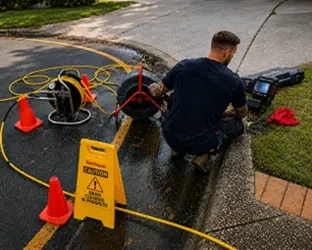
That is the point at which a camera earns its money, because clearing again treats an event that is not one.
In a building with high turnover, catching that pattern is the hard part.
Wipes and kitchen fat, from a whole building
Kitchen fat from a dozen flats cools onto the same length of stack and narrows it far faster than fat from one household would.
On cast iron that has already lost bore internally, there is less room to give up before trouble starts.
So both of the ordinary causes have more effect here than they would in a house of the same age.
What the footage settles
Whether the stack is restricted by material, by corrosion, or by a defect, and where. Those three look identical from a blocked toilet and have different answers.
The recording is yours whatever it shows, and for an owners corporation it is the thing that makes a decision possible at a meeting.
Ask for the file rather than a viewing, and keep it with the building's records rather than one person's phone.