A leak starts in a 1930s red-brick walk-up. The person standing in it is very often a renter, and they cannot authorise any work. The block is self-managed, so there is no building manager to ring. The committee may be two owners, one of whom is overseas.
And because the stack is shared and original, the useful first question is not how to fix the leak. It is whose pipe it is: lot property, or common property. In a block with no manager and no records, nobody on site knows, and the plumber is frequently the first person to establish it.
Work inside the lot is the owner's. Work on the common stack is the owners corporation's. In a small self-managed block nobody on site can tell you which, so the first move is establishing who the work is for, before anybody is asked to approve anything. Your registered strata plan and by-laws are the authority, and they differ between schemes.
- Find out who the strata secretary or committee actually is, before you need them
- Notify them as soon as a leak appears, even if it is small
- Do not authorise work on a pipe that may not be the lot's
- Ask the plumber to establish whether the line serves one unit or several
- Get the finding in writing, whichever way it goes
On this page
1. What these blocks actually are
The stock that defines this area is the red-brick walk-up: two or three storeys, six to twelve units, one or two shared stacks, original risers, no lift and no basement. Alongside it sit Federation and Edwardian houses and interwar duplexes, so the suburb is not uniform, but the walk-up is what makes plumbing here different.
The critical feature is not the age. It is that nobody is on site. There is no manager, no office, and frequently no professional strata agent either, because a block this size is often self-managed by the owners themselves.
So when something fails there is no obvious person to call, and no filing cabinet with the building's history in it. That absence is the actual problem, and it is why the sequence here is different from anywhere with a manager.
In a block largely occupied by renters, the person who finds the problem is almost never the person who can approve fixing it. That is the situation, and pretending otherwise wastes days.
2. Lot property or common property
Broadly, pipework that serves only your apartment and sits inside your lot is the owner's. Pipework that serves more than one apartment, or runs through the structure, is usually common property and the owners corporation's.
That is enough to know who should be told. It is not enough to settle a dispute, and we would rather say so. The boundary is defined by your scheme's registered strata plan and its by-laws, and schemes genuinely differ.
- Usually the lot owner's. Taps and mixers, the flexible hoses under the sink, the cistern, the fixtures, and the short branch runs serving them.
- Usually common property. The stack, the riser, the main supply into the building, and anything serving more than one unit.
- Frequently argued over. Waterproofing membranes, branch lines running inside a slab, and anything embedded in structure.
In a block with no records, the third category is where most of the difficulty lives, and it is exactly where a physical inspection is worth more than an opinion.
3. How it actually gets established
With no plans and nobody who remembers, the answer comes from the building rather than from paperwork.
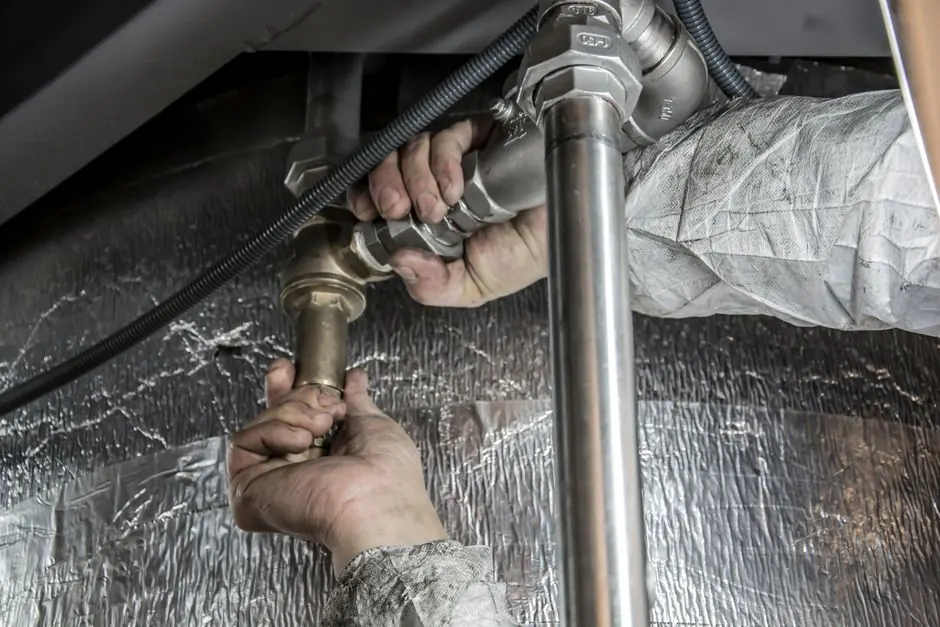
The practical question is whether the line in question serves one apartment or several, and that is usually answerable on site: where it runs, what it connects to, whether the fault behaves differently when other units use water, and whether neighbours have symptoms at all.
That does not give you a legal determination. It gives you the physical fact underneath it, which in most of these cases is all anybody actually needed. The disputes that get difficult are nearly always disagreements about facts rather than about principle.
4. What to do, in order
- Photograph it, dated, before anything is touched.
- Contain it and move anything that will be damaged.
- Notify the strata secretary or committee. In a self-managed block that is another owner, so it may take a couple of attempts.
- If you are renting, tell the agent as well. They are the ones who deal with the owner.
- Do not authorise work on anything that might be common property.
- Ask whoever attends to establish whether the line serves one unit or several, and to put that in writing.
Leak in a small block with no manager?
We will establish whether it is the lot or the stack before anybody approves anything.
5. Find out who to call before you need them
This is the single most useful thing anybody in one of these blocks can do on an ordinary afternoon, and almost nobody has done it.
- Who is the strata secretary, and how do you reach them out of hours?
- Is the scheme self-managed or is there an agent?
- Where is the water isolation for your lot, and can you actually get to it?
- Is there an isolation for the building, and who has access?
- Does anybody hold a copy of the strata plan?
- Has anybody ever had the drainage or the risers inspected?
Six answers, obtainable over a couple of conversations at the letterboxes, and they convert a 2am emergency from a crisis into a phone call.
6. What we will and will not settle
We can trace where water is coming from and show you the evidence. We can repair what is the lot's. We can tell you, physically, whether a line serves one apartment or several, which is usually the question underneath the legal one.
We cannot tell you who is liable under your scheme, interpret by-laws, or settle a disagreement between an owner and an owners corporation. Your registered strata plan and, where there is one, your strata manager are the authority on that.
In a self-managed block that can feel unsatisfying, because there is no obvious authority to point at. The honest answer is that the plan is the authority even when nobody has read it, and the useful move is to find the copy rather than to have somebody guess.
- The defining stock here is the small red-brick walk-up with a shared stack and no manager.
- The person standing in the leak is usually a renter who cannot authorise anything.
- Work inside the lot is the owner's; work on the common stack is the owners corporation's.
- Nobody on site knows which, so establishing it is the first move rather than the last.
- Whether a line serves one unit or several is a physical question the building answers.
- Find out who your strata secretary is, and where the isolation valves are, before you need them.
Whose pipe in a walk-up FAQs
Who do I call in a self-managed block?
The strata secretary or a committee member, which in a small block is another owner rather than an office. It is worth finding out who that is now, because doing it during an emergency is considerably harder.
I am renting. Can I just get a plumber in?
For something clearly inside the lot, tell the agent and follow their process. For anything that might be common property, do not authorise work, because commissioning repairs to somebody else's asset is not a position you want to be in.
How do you tell whose pipe it is?
Physically, on site: where the line runs, what it connects to, whether other units are affected, and whether the fault changes when neighbours use water. That gives you the fact. The legal boundary comes from the registered strata plan.
The block has no records at all. What then?
That is common and it is workable. The building itself answers most of the practical questions, and a camera inspection or a trace gives you evidence rather than an opinion. It is also a reason to start keeping records from now on.
Nobody on the committee is responding. What can I do?
Keep a written record of every attempt, and if you are renting, keep the agent informed. Beyond that it becomes a strata question rather than a plumbing one, and it is worth proper advice rather than ours.
Is a leak in my ceiling the flat above?
Frequently, but not always. Water runs along a slab or a joist before it drops, so the source can be laterally some distance away or on a shared line. Trace it rather than assume, because a wrong conclusion here is somebody else's ceiling.